Creative Tours: Opening New Directions for Hanoi
In recent years, Hanoi has seen a growing number of experiential tours linked to heritage, creativity, and urban life. The common thread among these models is that they do not approach the city as disjointed sightseeing spots; instead, they organize experiences into narrative-driven journeys that connect multiple spaces, layers of memory, and diverse stakeholders. From short-term experiments within festival frameworks, several tours have gradually evolved into independent products, demonstrating a new approach to integrating knowledge, memory, and cultural practices into in-depth tourism experiences.
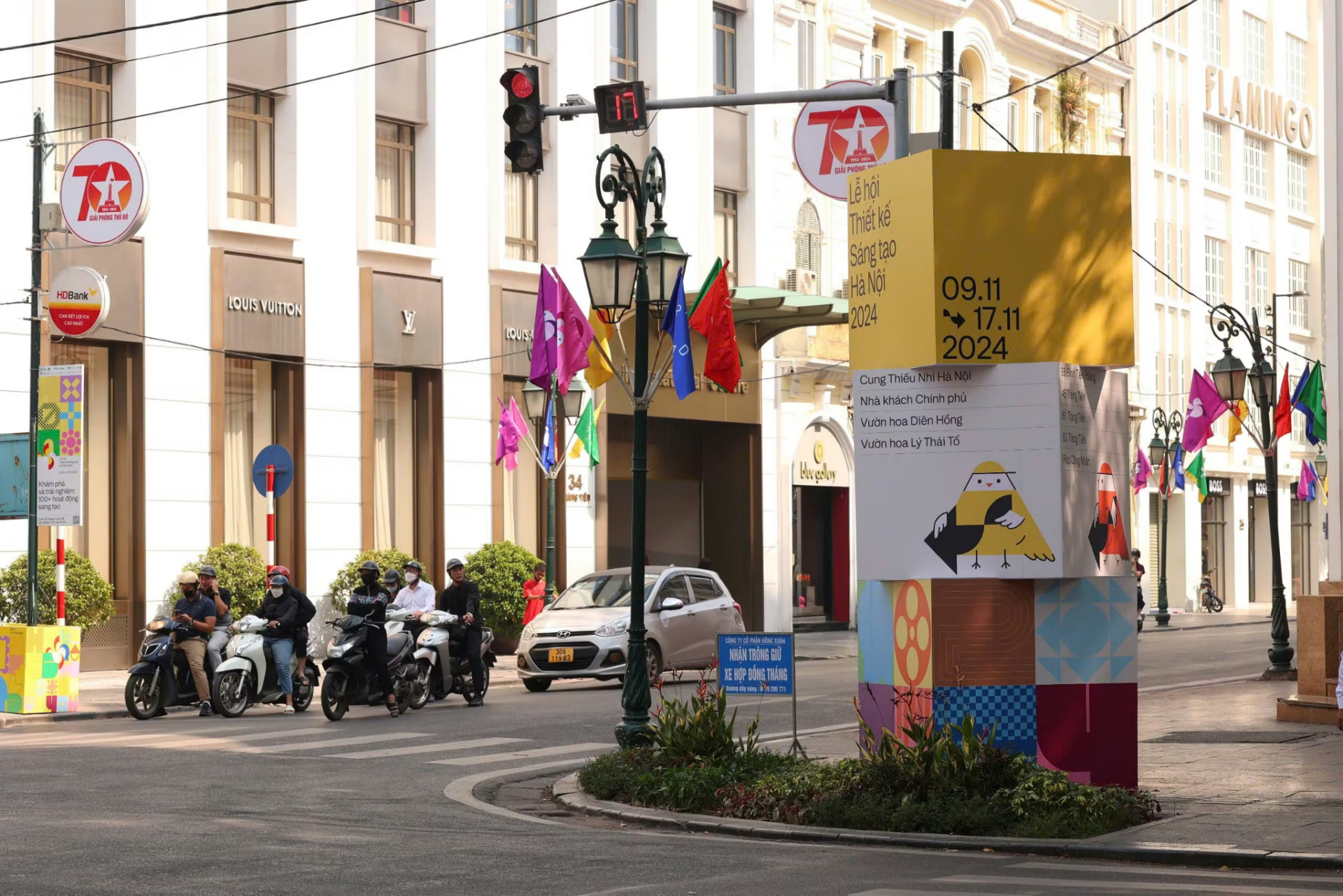
Experiments at the Hanoi Creative Design Festival 2024
Within the framework of the Hanoi Creative Design Festival 2024, creative tours were introduced as an experiential component alongside exhibitions and art programs. These tour routes were designed around key historical landmarks of the city, which also served as festival venues, including museums, theaters, universities, and several public spaces opened to the public for the first time or on rare occasions.
These tours did not appear as auxiliary activities but were positioned as an experimental layer in “reading” the city through guided experiences. Each tour was constructed along a specific route with a clear content script, directly linked to festival spaces and historical monuments being “activated” by contemporary creative practices.
Hanoi Creative Design Festival 2024. Photo: Organizing Committee
A notable feature is how these tours integrate heritage, creativity, and people within a singular journey. Several routes focus on the architectural-historical axis, passing through landmarks such as the The Tonkin Palace (Government Guest House), the Hanoi Opera House, the National Museum of History, and the Hanoi University campus. The tour content transcends mere introductions to dates or architectural styles, expanding into narratives about spatial usage across eras, the buildings’ roles in political-cultural life, and how creative festival activities foster a dialogue with those layers of memory.
Alongside architectural routes, certain tours are designed with a curated experiential approach. In these journeys, the guides are not conventional tour leaders but include architects, researchers, artists, or creative practitioners. This method allows participants to access professional, in-depth information while gaining a clearer understanding of the logic behind venue selection, exhibition organization, and the relationship between the artworks and the surrounding urban space.
The festival also serves as a backdrop for testing technological applications in tour organization. The public can access information, book tours, and pay online, while utilizing tools to personalize their journeys—such as selecting themes of interest, walking pace, or experiential formats. This indicates that creative tours are being approached as designed cultural-service products, rather than traditional guided group activities.
More importantly, the tours at the Hanoi Creative Design Festival 2024 function as a test of collaborative capacity. Real-world operations raise a series of specific questions regarding licensing, heritage access limits, tour duration, and value-sharing among organizers, management agencies, travel agencies, creative teams, and the public. These issues are revealed through practice rather than remaining at the level of policy orientation.
From these experiments, creative tours at the festival offer participants a new way to approach heritage, aiming to build a structured, content-driven, and well-designed experience chain—becoming a vital component of the ‘soft infrastructure’ within a creative city.
The ‘Flagpole Memories’ Tour: Layering the Heritage Experience
From experiments conducted within festival frameworks, several tour models have continued to evolve into independent products. The ‘Flagpole Memories’ tour serves as an exemplar of restructuring heritage experiences through a layered approach, integrating architectural sightseeing, documentary displays, artistic performances, and technological applications.
The tour route guides visitors through the various levels of the Hanoi Flagpole, with each tier linked to a specific layer of information regarding the monument’s history, architecture, and functional context across different eras. Parallel to the physical tour, the thematic exhibition ‘The Hanoi Flagpole and the Aspiration for Peace’ provides additional historical documents, imagery, and interpretative content.
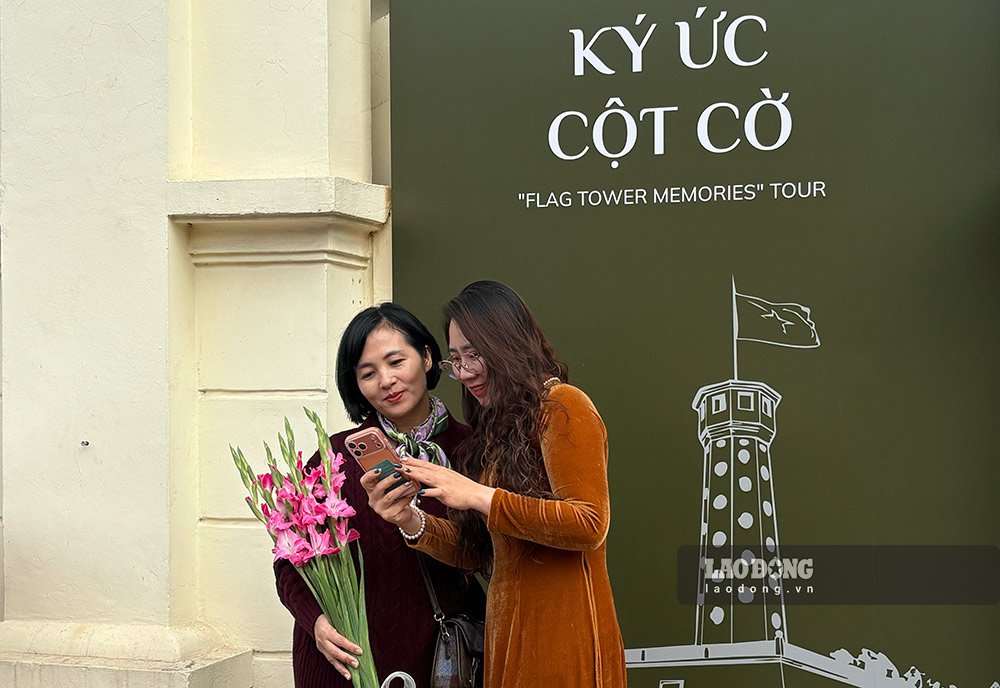
A check-in corner for visitors experiencing the “Memories of the Flagpole” tour. Photo: Ý Yên/Lao động
A highlight of the tour is a concise artistic performance utilizing theatrical elements, music, and visuals to reenact pivotal historical milestones, from the ‘National Resistance Day’ to the ‘Liberation of the Capital.’ The journey concludes with a ‘light’ experience featuring a tea party, photo opportunities, and heritage-themed souvenirs.
Overall, the tour demonstrates a concerted effort to transition from linear sightseeing to a rhythmic journey, where knowledge and emotions are organized in a clear, deliberate sequence.
Heritage Tourism Routes in Hanoi: ‘Reading’ the City through Data
The project ‘Heritage Tourism Routes in Hanoi’ approaches heritage tours from a foundation of research and data. The four routes within the project are not constructed as disjointed sightseeing tours, but rather as four distinct ways of ‘reading’ the same city.
The ‘Thang Long Four Sacred Temples’ (Thăng Long Tứ Trấn) route connects the guardian temples of the ancient citadel, allowing participants to observe the overlap between ancient spiritual structures and the modern urban landscape. The ‘Mother Goddess Temples’ route reflects how the Three Realms (Tam Phủ) belief system persists and spreads throughout urban life across various areas. The ‘Guild Temples’ route links architectural heritage with the history of guilds and craft memories within the Old Quarter. Finally, the ‘Hanoi Pagodas’ route approaches Buddhism as a continuous flow within the process of urbanization.
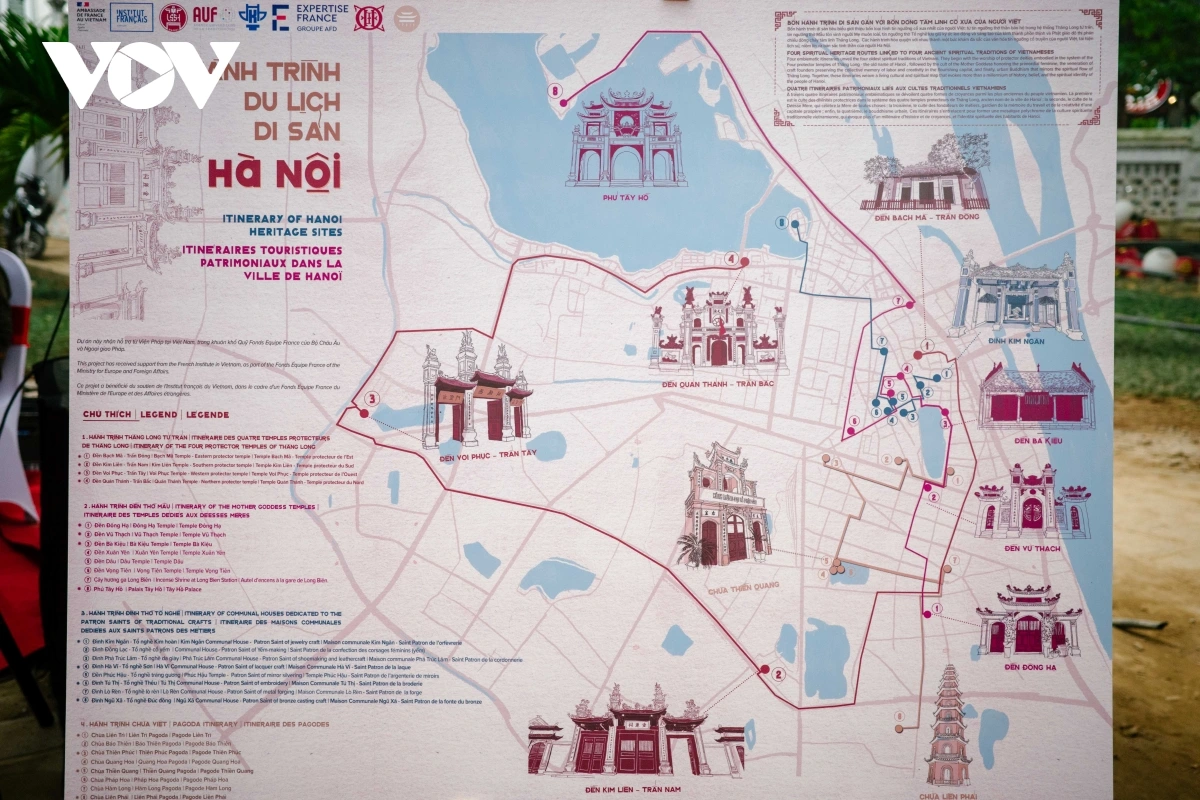
The project opens up a new approach: transforming Hanoi into a “living museum” in the digital age. Photo: VOV
Through the H-Heritage application and QR code systems at each site, users can access scientific dossiers, documentary photos, videos, and interactive maps on-site. This organizational method allows the tours to operate flexibly, simultaneously serving tourism, education, and research, rather than being limited to a short-term experience.
Hanoi Culture & Art’s Walking Tours: Walking to Deepen the Understanding of Hanoi
Within Hanoi’s urban experiential tour ecosystem, Hanoi Culture & Art has developed two distinct types of walking tours, each with its own specific objectives and structures.
The standard Walking Tour focuses on ‘reading’ urban spaces through observation, listening, and dialogue. Tours such as ‘Hanoi Night Walk’ or ‘Collective Housing Architecture – A Model Lifestyle’ guide participants through history, architecture, and urban life via streets, people, and the functional context of space. This format does not delve into manual crafts but prioritizes understanding the city’s structure and rhythm of life.
In tandem, the Artisan Walking Tour expands the experience into the depth of vocational practice. In addition to walking and learning about the history of trade streets, participants directly observe the production process, try basic techniques under the guidance of artisans, and create their own personalized products. Tours such as ‘Embroidery Soul in the City,’ ‘Fragrance of Ke Cho,’ or ‘Gilding on Lacquer’ demonstrate how vocational heritage is integrated into the experience through knowledge, skill, and the sensation of touch.
The parallel development of these two walking tour formats reflects a flexible approach to urban heritage, allowing the public to engage at various levels, from observation to hands-on practice.
Hanoi City Map and Tours: Designing Thematic Journeys
Hanoi City Map and Tours approaches tours as educational and multi-sensory experiences. Programs are designed along specific routes and themes, combining knowledge, urban observation, and interactive activities, based on the philosophy that cultural narratives should be told by those who live and practice them.
The group categorizes its products into Locaventure for general audiences and Eduventure for students or those seeking deeper insights. The ‘Pho Hang Tour’ focuses on interpreting the trade street system as a map of urban memory, while the ‘Hanoi Night Tour’ approaches the city through the rhythm of life and spatial sensations after sunset, including light experiences and nocturnal cultural activities.
Overall, creative tour models in Hanoi indicate a shift from destination-based sightseeing to structured journeys. Heritage in these tours no longer stands in isolation but is positioned within a spatial, historical, and contemporary life context. This signifies the potential to form a ‘soft experience infrastructure,’ where the city tells its own story through carefully designed and in-depth journeys.